Thursday, May 31, 2018

Active Learning

Active Learning

Source
Active learning is a form of learning that involves the students in more than just listening. In active learning, students are active participants and are engaged in their learning experience and collaborate with each other. The concept behind this is that students don't actively learn anything by just sitting in class and absorbing the material. Who remembers the days of memorizing and forgetting content? Well, this form of learning aims to eliminate that!


Promote Active Learning
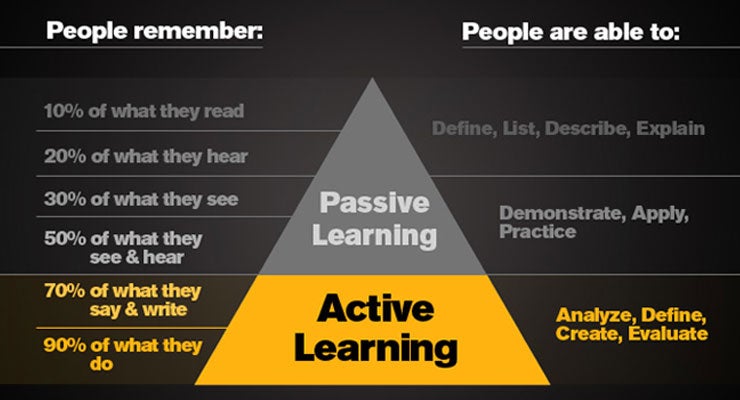
Active Learning vs Passive learning/Source
As you can see from the pyramid above, active learning is exponentially more effective than passive learning. There are two ways to promote active learning. One way is to have a mini lecture, thats no long than 20 minutes long, waits for students to make notes and finds any learning gaps that may have occurred in the lesson. The second way is to listen to a lecture for 20 minutes, don't take any notes, and then collaborate as a class/small group to elaborate on the lecture. Which one do you prefer? I'm totally in favor of the second technique! 


How I Apply This

I don't do too much teaching in my field. However, I apply this in my dietetics setting. I teach patients and residents how to carb count. Then I ask them to repeat and explain what I've just taught them. Then, together, we carb count their menu for the next day. This helps them better learn and apply what I've taught and put it in to action.

A Year In Six Words

This was based on a project for Coonley, a Chicago Public School. grades 1-7 were told to write their favorite part of their school year in six words! The students were told to reflect and base their memoir on: 

  • Telling something you like about Coonley 
  • What activity did you really enjoy this school year? 
  • Write about yourself 
  • Give advice to others

This was a great way for students to reflect, think and collaborate together. Here's the link to see some of the students creative words! I also provided a photo and link to my Padlet.

Thursday, May 24, 2018

Mapping of My Digital Space

Digital Mapping Space

Have you ever thought about where you spend on the most time online? If you're anything like me, you love social media! Instagram, Facebook, Twitter, and Snapchat are among my favorite applications that I use most. However, there's other applications I'm currently using right now that I thought I'd give more insight on and how I apply some of them. For this weeks blog post, I want to share a mapping of my digital space. This activity definitely puts things into perspective!

How To Get Started

The easiest place to start is to figure out what applications you're using the most. Then, you should categorize them in what purpose you use them for: personal or professional. From there, you should determine whether you're a visitor or resident. If you're a visitor on that application, this means you're using it for a specific goal or task. If you're a resident, this means you often go to this application to connect or be with other people (i.e. social media). If you're interested in learning more or want to make your own map, click here.

My Digital Map Space

As you can see, I spend a lot of time on my phone and laptop with all these applications, ha! I enjoy connecting with my family and friends. However, I do find certain applications helpful for getting information. For example, the Waze application is a GPS that, not only helps me get around, but also tells me how long it'll take me to get to my destination in current traffic and any hazards or construction along the way. 

Another website I visit often is The Academy of Nutrition and Dietetics. The website gives me tools and information to apply to my clinical experience. It has research articles, books, and even health tips.


Digital mapping is a good idea to also figure out what applications you're just wasting time and space on your phone! Focus on the applications that are useful and you get enjoyment out of. You will find more success this way!


Thursday, May 17, 2018

Evaluating Framework

SAMR

photo credit
SAMR allows educators to see the purpose of integrating technology in the classroom. SAMR is an acronym that stands for: Substitution, Augmentation, Modification, and Redefinition. Substitution refers to tech as acting as a direct tool substitute, with no functional change. Augmentation refers to tech as a direct tool substitute, with functional improvement. Modification refers to tech that allows for significant task design. Lastly, redefinition refers to tech as it allows for the creation of new tasks, previously inconceivable.

How Is This Used?

For example, in the picture below, you will see a picture of coffee. This is an example of substitution. As you can see, it is a plain, simple cup of coffee with no change.


Next, you will see a picture of a latte below. This is augmentation and has a functional improvement. It has coffee elements, but has been changed to a slightly different form.


Latte

Here, we have an iced caramel macchiato. This is an example of modification, creating options we couldn't or wouldn't have thought about. We took the coffee, and transformed it into an iced caramel macchiato.


iced caramel macchiato

Lastly, we have an iced pumpkin spice latte. This represents redefinition. Something that would have been impossible to make from coffee without the use of technology (also very delicious!). 


iced pumpkin spice latte

Where Do I Find Myself?

Although I do appreciate technology and what it can do to expand on information, I believe it can become a setback if not used adequately. If I'm being honest, I think I'm in the augmentation category. While I do prefer technology in the classroom, too much technology can hinder the learning experience.

I think if I can come to a full understanding of redefinition, I'd be able to move to that category. I do find too much technology a bit overwhelming, and at times, I find myself spending a few minutes to figure certain things out. 

Click here for more information on how to integrate SAMR into your class! 

Thursday, May 10, 2018

About me


Background

Hi, my name is Rana Ahmad and I'm a masters/internship student in Dietetics at Dominican University Crossing my fingers everything goes well! I currently work at Marianjoy Rehabilitation Hospital as a Registered Dietetic Technician (DTR). I want to become a Pediatric Dietitian. My future goal is to work in the neonatal intensive care unit to help premature babies thrive and grow. I truly believe I have the best support system to do this as my family and friends. Speaking of, I recently got married and this year we will be celebrating our 2 year anniversary come August.
Engagement photo
Wedding photo

Family

I believe family is everything. I come from an incredibly close family. After I got married, I moved about an hour away from them. For some people, that's still close. For me, it's too far! We make it work, though. Beyond my busy schedule, we still talk, facetime and text each other every day. 
Extra points if you can find nephew #3

I also have three nephews and they are my whole world. I've watched them grow into the sweetest boys anyone could ever ask for! 

Lucky I got a still photo of ALL three! 

Travel

I love to travel even though I hate being on airplanes for long periods of time (anything can happen!). I try to go to new places but there are places, like Las Vegas, that I will never get enough of. Something about the city life that I'm obsessed with! My favorite place I've been to was Greece. I went to Athens and Santorini and it was the most beautiful place I've ever seen in my life, filled with so much history. I lost my camera on my last day there, so I don't have any pictures, unfortunately! I hope to continue traveling when I can, visit new places, and meet new people.
Red Rock Canyon tour in Las Vegas, Nevada.

Social Media in Education

Do you have a difficult time understanding social media and all their fancy updates? When Twitter first came out, I was completely lost. Twe...